Showing posts with label money. Show all posts

Wednesday, March 6, 2013

Local Crime


We clearly live too close to Detroit. This is getting unbearable.


Saturday, April 21, 2012

Debt

At least once a week, Mrs. Newby or I - and sometimes both of us - receive offers of loans, another credit card or a chance to remortgage our home. All this junk mail goes straight into our recycling bin, but we seem to be the exception that proves the rule.

There are about 610 million credit cards in circulation in the States - almost two for every man, woman and child. On average, cardholders have 3-4 credit cards each, and a large proportion seem to use them as an alternative to a bank loan, only ever paying off the bare minimum. As a result, they currently owe a total of $2.5 trillion on their credit cards, or $8000 per person.

Believe it or not, that's only the tip of the iceberg. If you factor in debt on real estate, Americans together owe a staggering $13 trillion, i.e. $42,500 each.

The recent US housing bubble was a stark reminder of how this debt system has spiraled out of control: because banks made a fortune bundling and then reselling loans, they offered more and more people ever larger mortgages. And when the greedy banks ran out of eligible customers, they gave 100% mortgages to increasingly unsuitable borrowers - eventually even those patently unable to repay them (these loans were called NINAs: no income, no assets). After all, they knew that if the debtors defaulted, the banks could seize the house and auction it off, presumably at a profit because house values had  increased steadily for decades.

When the bubble burst and house prices plummeted, thousands of people found themselves "underwater", that is, owing far more than the value of their house. So many did the unthinkable: they declared bankruptcy, handed their house keys back to the bank and walked away from their property. Some, like our own neighbours, simply packed all their belongings and disappeared overnight.

Suddenly, banks found themselves owning masses of property worth far less than they were owed and which they couldn't sell anyway because nobody had the money to buy them. "For sale" signs littered streets across America - ours included - as did empty homes with repossession orders pasted to their windows. Yet no-one ever bought these houses, so they stayed empty for months and even years.

Oddly enough, little appears to have changed. To prevent the banks collapsing, the government bailed them out, and now they are again offering 100% mortgages. And people continue to live from one month to the next, using one credit card to pay another off.

We recently came across a startling example of how insane this borrowing is allowed to become: last month, the 85-year-old father of a friend of ours had to sell his family home of half a century and move into a shared flat because he couldn't afford to continue paying off his mortgage.

He and his wife bought the house for $40,000 back in 1961. Having taken out a second mortgage and borrowed on his house repeatedly over the years, he still owed the bank $110,000.

Thursday, October 28, 2010

Campaign Spending

America goes to the polls next Thursday, 4 November. And although these are only the "mid-term" elections rather than a presidential one, the Center for Responsive Politics, a non-partisan research group based in Washington, has calculated that the political parties, candidates and so-called "outside groups" will spend an estimated $4bn - I repeat, four billion dollars - on campaigning.

Just thought I'd share that figure with you.

Thursday, October 22, 2009

Odd Bank Statement

I know we've just lived through a financial meltdown, but should I be worried about the following bank statement?

(Click on the image to enlarge)

Saturday, September 19, 2009

Full Disclosure


It's a well-known fact that Americans donate millions to election campaigns. Thanks to FundRace, you can find out not only whether your friends and acquaintances made campaign donations, but also how much and to whom.

The system is brilliant: you can either search for donors by name or you can zoom in on the map of the US and search for donors by neighbourhood - even those in your street.

Frighteningly, FundRace lists not only the name of the donor, but their full address and occupation. But this also makes for interesting research.

For instance, George Bush sr. gave money to the McCain campaign, but "Dubya" did not. Bill - that is, William Jefferson - and Hillary Clinton both donated $2300 to Barack Obama's election campaign, yet neither spent (wasted?) money on Hillary's campaign.

What I really don't understand is that Barack Obama donated $6900 to the campaign of rival Hillary Clinton, while Michelle Obama donated $2300 to the Clinton campaign but a mere $399 to her husband's.

Former Alaskan governor and would-be vice-president Sarah Palin made no campaign donations whatsoever.

Thursday, May 7, 2009

Credit Scores


You could be mistaken for believing life revolves around credit scores here in the States. In many ways it does, and I believe the present financial meltdown may never have happened if banks had paid more attention to credit scores when handing out subprime mortgages. But I'm getting ahead of myself.

Everyone in the US has what is known as a "credit history" reflected in a score from 0 (the worst) to 900 (perfect), though anything over about 700 is considered good. Your credit score is supposed to measure your creditworthiness. Whenever you buy something using a credit card (an American obsession, and one I am beginning to understand given the twin problems of VAT-less pricetags and universally green banknotes), it affects your credit score. Whenever you take out a loan or mortgage, it affects your credit score. More importantly, banks and other organisations check your credit score whenever you apply for a credit card or a loan/mortgage. Low score? I'm sorry!

Strangely enough though, if I've understood this correctly, your credit score increases when you take out a loan, and decreases every time someone merely checks your score and turns you down for credit because it's too low (a great vicious circle, if ever I saw one).

More importantly to New World newbies like myself, when you first come to the States you have no US credit history and therefore automatically start with a credit score of "0" even if you've been using credit cards - including the US-owned Visa or American Express brands - for decades. This means that you are considered non-creditworthy, and can kiss goodbye to the idea of applying for a credit card or even leasing a car until you've built up credit history and a good credit score, which usually takes several years.

But here's the rub: how are you supposed to build up a credit score if you can't do any of the things - use credit cards, buy houses, lease cars, etc. - that increase your score? Now I know where Joseph Heller, the son of Russian immigrants, got the idea for his book Catch-22.

Box Tops

Box Tops For Education and the Campbell's Labels for Education programme are two great ways for families to earn their children's schools hundreds if not thousands of dollars to spend on whatever they like.
So far, Box Tops alone has raised $250 million for schools.


All you do is cut out the relevant labels on everything from cereal packets to soups, kitchen roll to nappies, and hand them over to the school, which then cashes them in. The programme bills the relevant manufacturer and sends the school a cheque. Given that each label is worth 10 cents, the money quickly piles up.

You can also earn Box Top credits for your school by shopping on the Internet at sites like gap.com, and at some shops - e.g. Kroger - you can even register your store card online and automatically get the Box Top credited to your nominated school every time you shop. That way, the school is paid twice for each label!

Knowing how cash-strapped schools in Britain are, wouldn't this be a great thing to introduce rather than relying on grants from the insane lottery, which only encourages people to gamble?

Thursday, April 16, 2009

Back to Basics

I heard an interesting report on NPR this morning about how the economic crisis was affecting people in the United States. One man they interviewed, who had been unemployed for a year, said, "I've really had to cut back. My kids love going to McDonald's, but we're cooking now."

The man's comments are telling because ready-to-eat food is so easy to get and indeed cheap in the States that many people eat out or order home-delivery meals almost every day of the week. Home cooking has thus therefore become more-or-less something for the extremely poor, a kind of culinary last resort.

Given that fast food in particular is high in salt, sugar and fat, is it any wonder that so many Americans are malnourished and/or obese?

Wednesday, March 18, 2009

The Colour of Money

I wonder who it was that had the bright idea to make all dollar banknotes the same colour and size.

Wednesday, March 4, 2009

Start Early

From the 'Enrichtment Camps' section of our local community education brochure for summer 2009:

CAMP MILLIONAIRE
(Ages 10-14)
Do you want your kids to get excited about managing their money? Do you want your kids to understand the value of a buck? Do you want your kids to grow up and live the lives they dream of? At Camp Millionaire you will empower your kids with the knowledge that they are fully in charge of creating their own lives, and that includes how much money that want to have when they grow up. Your child will walk out of our program truly feeling like they can be a millionaire one day.

The cost of the one-day course: $230.

Friday, February 27, 2009

Debt

I heard on the radio this morning that Americans now owe a cumulative $3 trillion ($3,000,000,000,000).

To get this into perspective, that's equal to the country's entire gross domestic product.

Only once before has the US national debt equalled GDP: in 1929.

Monday, February 16, 2009

Middle Names

Middle names are used completely differently in America - or rather, they are used on a daily basis rather than merely adorning your birth certificate. As a result, my daughter is routinely called "Anna Marie" by her teachers, and regularly has to explain that she only ever uses her first name. 

Things get more complicated if you have more than one middle name. In this case, the second and subsequent middle names are usually abbreviated for "daily" use, although bearers of just one middle name may abbreviate it anyway (e.g. George W. Bush) for clarity's sake.

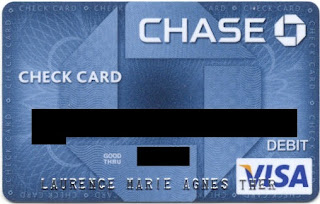
Because people use either their middle names or abbreviations thereof whenever referring to themselves, they also do so on application forms. However, being New World newbies, we did not know this, so when we opened a bank account, my wife duly listed her three middle names as directed. Unfortunately, this meant that she was issued with the following card, on which the first and middle names took up so much space that there wasn't enough room for them all - let alone the surname!


Needless to say, as someone with a three-letter first name and no middle name whatsoever, I did not have the same problem.

Wednesday, December 10, 2008

Expat's Dilemma


One of the pitfalls of moving from one country to another is having to get used to a different currency.

In my short life I have suffered no fewer than four such mental monetary realignments: moving from England to Germany (pounds sterling - deutschmarks), from Germany to France (deutschmarks - francs), European Monetary Union (francs - euros) and now the move from France to the United States (euros - dollars).
Each time I was confronted with a new currency, it took about two years to start "thinking" in the local currency. In the meantime, I went through something like the five stages of grieving:
  1. Denial (0-3 months) - My brain refuses to accept that I am in another country. All prices are automatically converted into the old currency in my mind;
  2. Insanity (4-6 months) - The new currency means nothing and is essentially Monopoly money. Everything therefore seems incredibly cheap. Stage 2 is the most dangerous part of the cycle, since I spend willy-nilly (this is where I am now);
  3. Depression (7-15 months) - Having lived with the new currency for some time, I start forgetting the reference points (the price of bread, alcohol, DVDs, etc.) in the old one. However, I still can't really get to grips with the new one. As a result, I don't understand anything anymore. This is theoretically the best time to move to another currency;
  4. Schizophrenia (16-24 months) - I have got used to the new currency and can more-or-less move from one to the other, though still reminisce about the one I have "left behind"; and finally
  5. Acceptance - The point of no return. I think only in the new currency forsaking all others.

Given that we're due to be in the States for about three years, I'll just have time to get used to the dollar before I'm back to square - and stage - one again. Unless, of course, Euroland is so smitten by President Obama that it decides to adopt the Greenback.